
Middle School
Prepared to Lead. Ready to Rise.
The academic program in KSDS Middle School mirrors the balance of academic excellence and intellectual curiosity in the Lower School, with further development of the critical thinking, executive functioning, and digital skills required for students to thrive in their education and beyond. Our integrated curriculum across all General and Judaic academic disciplines challenges students to analyze complex texts, conduct sophisticated research, and articulate ideas with precision and depth.
Students develop the academic foundations and learning mindset essential for future achievement and success. Our program prepares students to excel in Baltimore’s elite high schools through academic rigor, strategic mentoring, and ongoing support of executive functioning. KSDS graduates emerge as confident, capable learners and thinkers who cherish their lifetime friends and memories.
FIFTH GRADE
Fifth grade at KSDS is a year of discovery, synthesis, and application. Students think critically, write analytically, and connect learning across disciplines. With a focus on inquiry, reflection, and growing responsibility, students are well set up for success and confidence in their remaining years of middle school and beyond.
English: Through rich literature, research projects, and writing instruction, fifth graders explore themes of resilience, culture, and messages from the past. Core texts include The Birchbark House, Holes, and The Hero Schliemann, along with mythology, nonfiction, and student-selected independent reading. Students learn to construct detailed responses, write multi-paragraph essays, and use strategies from The Writing Revolution to strengthen sentence structure, organization, and clarity.
Grammar instruction focuses on mastery of parts of speech, sentence structure, and prepositional phrases. Students apply their grammar knowledge to structured writing tasks. Vocabulary instruction reinforces morphology with a focus on Latin roots and word analysis throughout the year.
Writing Workshop: Students receive targeted, small-group instruction to strengthen their writing skills across all subjects. Using The Writing Revolution framework, they progress from crafting complex sentences to composing well-structured paragraphs and multi-paragraph essays. Units include personal narratives, compare-and-contrast writing, persuasive essays, literary responses, and creative projects, which are each designed to build mastery in organization, grammar, and style. Students practice integrating quotes, developing thesis statements, using transition words, and refining their voice, with skills reinforced through ongoing review, reflection, and individualized feedback.
Math: Fifth-grade mathematicians work to strengthen and extend key skills developed in lower school, including operations with whole numbers, fractions, and decimals. They apply these computational strategies to real-world problem-solving while continuing to build fluency and deepen their number sense. Students are encouraged to explain their thinking, make connections, and develop flexible approaches to solving problems. Those in the accelerated fifth grade math track follow an enriched version of the sixth-grade curriculum, engaging with more advanced content and challenges to prepare them for Pre-Algebra the following year. Within the curriculum, there are also “Essentials” and “Foundations” level math classes available to provide students with additional support in smaller group sizes.
Science: Fifth graders take on the study of biology, exploring what it means to be alive, starting with the cell and progressing through the major human body systems. Units include the respiratory, circulatory, digestive, nervous, and reproductive systems, with emphasis on how each contributes to cellular function and homeostasis. Students also learn microscope skills, examine plant and animal cell structures, and complete hands-on projects and assessments throughout the year
Social Studies: 5th Grade Social Studies introduces students to the story of human civilization, from the earliest humans to the great societies of the ancient world. Students begin by exploring geography, maps and the history of the Earth to better understand how people and civilizations developed over time. Throughout the year, they investigate the Agricultural Revolution, the rise of early civilizations, economics and trade, cultural diffusion, ancient religions, systems of government and law, and the remarkable achievements of the ancient world. Students learn how geography, innovation and the exchange of ideas shaped civilizations and continue to influence the modern world. Instruction emphasizes historical inquiry through the analysis of primary and secondary sources, collaborative activities, simulations, research projects and a variety of reading and writing assignments designed to support diverse learners. As students develop their research and presentation skills, they learn to evaluate evidence, compare multiple perspectives and make meaningful connections across cultures, time periods and civilizations. Above all, the course encourages students to think like historians by asking thoughtful questions, exploring the past with curiosity and discovering how human history continues to shape the world today.
Hebrew Language: Students build on their foundational skills to deepen reading comprehension, writing fluency, and conversational confidence. Through engaging themes like Israeli culture, music, family life, and geography, they learn to express ideas in writing, hold structured conversations, and navigate authentic texts. Students strengthen core grammar and language structures that support accurate communication, while exploring cultural content including Israeli cities, schools, and holidays. Learning is enriched through songs, role-play, digital projects, and meaningful connections between Israeli and American life.
Jewish History & Israel: Using the book Israel: It’s Complicated, the students explore the Jewish people’s historic connection to the Land of Israel, dating from the time of Abraham and continuing through the Temples and into the modern day. They also look at the diversity of modern Israel, including the different waves of Jewish immigration and the many non-Jewish groups that contribute to the richness of the modern state.
Bible: Students build foundational skills in navigating and understanding the Tanach as the central text of the Jewish people. They begin with an introduction to its structure and content, then focus on the Book of Bamidbar, exploring the challenges faced by the Israelites in the desert. Through study of themes such as G-d’s provision of water, food, shelter, and guidance, students recognize G-d as the central figure in the narrative and deepen their appreciation for the enduring relationship between G-d and the Jewish people. Along the way, they develop the ability to critically read and interpret texts, strengthening both analytical and personal connections to Torah.
Jewish Traditions, Holidays & Prayer: The study of Jewish holidays in 5th grade is woven throughout the school year, aligned with the Jewish calendar. Students explore each holiday’s historical background, rituals, and meaning while engaging in experiential learning that brings the celebrations to life. Through both practice and reflection, they come to see the holidays as opportunities to connect with tradition, community, and spiritual growth, while also building a deeper understanding of the rhythm of Jewish life across the year. 5th graders gain comfort with the weekday prayer service, expanding from their Lower School prayer focus on Shabbat. They learn to chant from the Torah, they explore the symbolic and personal meaning of the tallit, and celebrate Shabbat with joyful Friday morning pre-Shabbat experiences.
SIXTH GRADE
Sixth grade is a year of exploration, independence, and growing leadership. Students deepen their skills across all disciplines including analyzing literature, tackling complex math and science concepts, and engaging in hands-on projects that connect learning to real-world contexts. With increasing responsibility and self-awareness, sixth graders begin to see themselves as active contributors to their classrooms, their community, and the world around them.
English: Sixth graders refine their skills as critical readers, thoughtful writers, and confident communicators. Through the study of novels, poetry, and nonfiction, students analyze theme, character, and author’s craft while making connections to their own experiences and the multi-cultural world around them. Core texts include Esperanza Rising, The Giver, Inside Out and Back Again, and Refugee. Writing becomes more sophisticated as they practice persuasive, analytical, and creative forms, emphasizing clarity, structure, and voice. Vocabulary development, grammar study, and discussion-based learning strengthen their ability to express ideas effectively and think deeply about language and meaning.
Grammar instruction focuses on mastery of parts of speech, sentence structure, and prepositional phrases. Students apply their grammar knowledge to structured writing tasks and five-paragraph essays. Vocabulary instruction reinforces morphology and word analysis throughout the year.
Writing Workshop: Students receive targeted, small-group instruction to strengthen their writing skills across all subjects. Using The Writing Revolution framework, they progress from crafting complex sentences to composing well-structured paragraphs and multi-paragraph essays. Units include personal narratives, compare-and-contrast writing, persuasive essays, literary responses, and creative projects, which are each designed to build mastery in organization, grammar, and style. Students practice integrating quotes, developing thesis statements, using transition words, and refining their voice, with skills reinforced through ongoing review, reflection, and individualized feedback.
Math: The sixth grade math curriculum expands students’ understanding of numbers and relationships by introducing operations with negative integers, as well as real-world applications of percents, rates, and proportions. Students begin working with algebraic thinking, solving one- and two-step equations, and using variables to represent real-life situations. Emphasis is placed on reasoning, problem-solving, and clearly communicating mathematical ideas. Students in the accelerated track engage with an enriched version of the seventh grade Pre-Algebra curriculum, which prepares them for the transition to Algebra 1 the following year. Within the curriculum, there are also “Essentials” and “Foundations” level math classes available to provide students with additional support in smaller group sizes.
Science: Units include geology and the Earth’s layers, evolution and natural selection, the scientific method, metric measurement, and ecology. Students complete hands-on labs, design science fair experiments, and develop scientific reasoning. A spring highlight is the four-day immersive ecology experience at Pearlstone Center, where students connect their classroom learning to environmental stewardship and Jewish values.
Social Studies: 6th Grade World Geography and World Geography and Cultures explores the relationship between people, places and the forces that have shaped civilizations throughout history. Students begin by developing geographic literacy through the study of maps, globes, latitude and longitude, and the Five Themes of Geography, learning how geography influences human settlement, migration, trade and cultural exchange. Building on this foundation, the course examines the rise and fall of the Roman Republic and Empire, the spread of Christianity, Medieval Europe, the Renaissance, the Reformation, the Scientific Revolution and the Enlightenment. Throughout the year, students investigate historical and geographic questions by analyzing primary and secondary sources, examining real-world case studies and making connections between the past and present. Instruction emphasizes critical reading, effective note-taking, research, writing and evidence-based argumentation through collaborative activities, simulations and interdisciplinary projects. As students refine their research and organizational skills, they learn to evaluate evidence, communicate their ideas clearly and appreciate the lasting influence of geography, culture and innovation on the modern world.
Hebrew Language: In sixth grade, students expand their vocabulary, strengthen grammar skills, and learn to express ideas and opinions in increasingly complex sentences. Through stories, dialogues, and cultural exploration, students deepen their connection to Israel and modern Hebrew life. Emphasis is placed on conversation and comprehension, helping students use Hebrew naturally and meaningfully in everyday and classroom settings.
Bible: Sixth grade Bible study focuses on the theme of personal responsibility as a Jew, drawing from all three sections of the Tanach. Students explore stories from Judges, Leviticus, Esther, and Ruth, learning to navigate a printed Tanach, interpret midrashim, and connect ancient values to modern life. Units include themes like leadership, holiness and social justice, dietary laws, and the complexities of identity and conversion through Ruth. Students learn to analyze texts critically and support their interpretations with text citations and commentary.
Jewish Traditions, Holidays & Prayer: Holiday learning is woven throughout the year, with a focus on how traditions and symbols evolve over time. Students explore the origins and modern observance of holidays like Rosh Hashanah, Sukkot, Hanukkah, Purim, Passover, Tu BiShvat, and Shavuot. They examine how symbols (like seder foods or Purim masks) tell stories, and they connect holidays to values such as teshuvah, hesed, and Jewish peoplehood. Creative activities include debates, art, and experiential projects that bring Jewish time to life in meaningful ways. 6th graders gain in ownership and mastery of the weekday morning service, practice putting on tefillin, and build their leadership skills within prayer experiences. The entire middle school celebrates Shabbat with joyful Friday morning pre-Shabbat experiences.
Jewish History & Israel: The Jewish History curriculum highlights choices and challenges faced by the Jewish people in ancient times. Students study the rise and fall of both Temples, the age of prophecy, exile and diaspora, and the emergence of Rabbinic Judaism after the Bar Kochba revolt. Units explore Jewish resistance and resilience—from the Maccabees and Masada to modern commemorations like Tisha B’Av. Students are encouraged to reflect on how Jewish communities adapted to adversity and how those choices continue to shape Jewish identity today.
Building on their 5th grade foundation, students continue learning about modern Israel through the lens of the book Israel: It’s Complicated. Topics include innovation and creativity, Israel’s place in the global community, and the ongoing challenges and opportunities of peace and conflict. The unit culminates in a creative project that prepares students for their 8th grade Israel experience and deepens their connection to the people and land of Israel.
SEVENTH GRADE
Seventh grade is a year of deepening curiosity, critical thinking, and self-discovery. Students tackle more advanced academic challenges—analyzing literature and historical events, exploring scientific inquiry, and applying mathematical reasoning to complex problems. In Judaic Studies, they engage in rich text study, thoughtful discussion, and exploration of Jewish values that connect ancient wisdom to modern life. Through collaborative projects, leadership opportunities, and reflection, seventh graders strengthen their voices, expand their perspectives, and grow as independent learners and responsible members of their community.
English: Through novels, nonfiction texts, and poetry, students explore the journeys of characters who find their voice and purpose. Core texts include Blood on the River; James Town 1607, Chains, Lyddie, African Town, and The Invention of Wings, with cross-curricular connections to social studies and a focus on historical and cultural contexts. Students participate in socratic seminar discussions and conduct a structured research project on an important historical figure, which culminates in a storytelling presentation.
Vocabulary development is integrated throughout the year, and grammar is taught systematically, covering advanced parts of speech, verbals, sentence structures, and clauses.
Math: Seventh grade Pre-Algebra students deepen their algebraic reasoning by solving equations that represent real-world situations. They study linear relationships by exploring slope and intercepts, learning how to graph lines and interpret linear models. The curriculum also introduces foundational concepts in probability and statistics, helping students analyze data and understand variability. Accelerated seventh graders follow the eighth grade Algebra 1 curriculum, which includes a more rigorous and in-depth study of these algebraic concepts, and which earns students a Maryland high school Algebra 1 credit in the process. Within the curriculum, there are also “Essentials” and “Foundations” level math classes available to provide students with additional support in smaller group sizes.
Science: Seventh grade science begins with classification of organisms, cell biology and a study of DNA before shifting into physical science and environmental issues. Students explore matter, atoms, chemical reactions, and the periodic table before examining human impact on climate change. The climate science unit fosters real-world understanding and inquiry-based learning. Labs, projects, and discussions encourage students to apply scientific reasoning to global challenges.
Social Studies: 7th Grade U.S. History explores the development of the United States from the first peoples of North America through the nation’s expansion and the growing sectional tensions that led to the Civil War. Students begin the year by learning how historians gather, evaluate and interpret evidence, providing the foundation for the historical inquiry and critical thinking skills that are emphasized throughout the course. Major units include Indigenous civilizations, European exploration, colonization, the transatlantic slave trade, the American Revolution, the Constitution and Bill of Rights, the Early Republic, westward expansion, reform movements and the events that ultimately placed the nation on the path to civil war. Throughout the year, students investigate historical questions by analyzing primary and secondary sources, evaluating multiple perspectives and constructing evidence-based arguments. Instruction incorporates Project-Based Learning (PBL), Structured Academic Controversy (SAC), simulations, document analysis, collaborative activities and a variety of reading and writing assignments designed to support diverse learners. Above all, the course encourages students to think like historians, asking thoughtful questions, weighing evidence and developing a deeper understanding of the people, events and ideas that have shaped the United States.
Spanish: Seventh-grade Spanish builds a strong foundation in language structure, focusing on how Spanish works. Students gain a solid understanding of grammar, including morphology, phonology, and syntax through translation exercises, grammar practice, and songs. Beginning with simple sentences and progressing to longer stories, students strengthen their reading, writing, listening, and speaking skills.
Hebrew Language: Students advance their reading, writing, speaking, and listening skills while deepening their connection to Israeli culture and Jewish life. Through real-world themes such as travel, health, technology, volunteerism, and everyday life, students strengthen core grammar and language structure that support accurate communication. Units integrate authentic materials like songs, maps, menus, and biblical excerpts, encouraging students to compare Israeli and American life, engage with cultural traditions, and express their own opinions in Hebrew. By year’s end, students can read and understand longer texts, write with greater accuracy, and converse confidently in a variety of settings.
Bible: In seventh-grade Bible, students explore the themes of leadership and the creation of a just society through close study of Jonah, Deuteronomy, and Samuel I & II. They examine prophetic responsibility, mercy versus judgment, and the power of repentance in Jonah; the foundations of justice, the Ten Commandments, and the seven species of Israel in Deuteronomy; and the shift from prophetic to king-based leadership, moral complexity, and human imperfection in Samuel. Throughout the year, students strengthen skills in text navigation, using Hebrew and English citations, commentary analysis, and critical writing.
Rabbinics: Students explore the development of Jewish law and thought from the destruction of the Second Temple through the Talmudic period. They study key texts from the Mishnah, engage in hevruta (partner) learning, and examine how the Rabbis responded to historical challenges by creating a portable Judaism rooted in study, prayer, and community practice. Students connect ancient debates and interpretations to modern ethical questions, deepening their understanding of how Rabbinic tradition shapes contemporary Jewish life.
Jewish Traditions, Holidays & Prayer: Holiday studies in seventh grade focus on historical origins, evolving traditions, and contemporary observance. Students explore the biblical and rabbinic foundations of major chagim, examine how customs developed across time and place, and reflect on how these practices express enduring Jewish values. Each holiday unit integrates text study, experiential learning, and discussions that connect ancient rituals to students’ personal and communal experiences today. 7th graders explore the b’nei mitzvah experience together as a community, shifting to personal adult obligations as prayer community members and leaders. The entire middle school celebrates Shabbat with joyful Friday morning pre-Shabbat experiences.
Jewish History & Israel: Students explore pivotal moments relating to the building of Jewish communities around the world and in America in particular, focusing on Jewish resilience, identity, and leadership. The students look outwards, at the diversity of Jewish experiences, and also inwards, at their own family history The Israel component picks up on the theme of immigration and highlights the challenges and successes of the different pre-state waves of aliyah to the Land of Israel. Through primary sources, discussion, and research, students consider the interconnectedness of Jewish history and the modern Jewish community.
EIGHTH GRADE
Eighth grade is a culminating year of reflection, advocacy, and academic rigor. Students refine their skills and prepare for the transition to high school. The central theme, “Upstander: Taking Action for Justice,” invites students to explore the role they play in building a more just and compassionate world.
English: Students read powerful texts that explore justice, identity, and courage—including Anne Frank: The Diary of a Young Girl, The Book Thief, Warriors Don’t Cry, Roll of Thunder, Hear My Cry, and To Kill a Mockingbird. They write multi-paragraph literary analysis essays, conduct research using primary and secondary sources, and deliver oral presentations that reflect their learning.
The capstone English project is the Upstander Research Paper, where students investigate a historical or contemporary figure who took a stand for justice. They take detailed notes, organize citations, and write a full research paper with a companion creative piece.
Grammar instruction builds mastery of sentence structure, phrases and clauses, and verbals. Exposure to advanced vocabulary is gained through reading complex texts and explicit instruction based on Latin and Greek roots. Students apply their English language skills to craft writing with greater intentionality and sophistication. They graduate from 8th grade with the critical reading, thinking, and writing skills that will make them confident and successful students in any high school classroom. Vocabulary development is woven throughout the year, and a poetry unit allows students to analyze structure, style, and meaning across cultures and eras.
Math: Eighth grade Algebra 1 students earn Maryland high school credit by exploring key algebraic concepts including linear equations, linear inequalities, polynomials, and quadratic functions. They learn to factor trinomials and solve basic quadratic equations, applying these skills to real-world problem solving. The course emphasizes both procedural fluency and conceptual understanding to prepare students for future success in mathematics. Accelerated eighth graders earn Maryland high school credit in Geometry through a proof-based study of parallel lines, triangles, quadrilaterals, and other foundational geometric concepts. Within the curriculum, there are also “Essentials” and “Foundations” level math classes available to provide students with additional support in smaller group sizes.
Science: Eighth-grade science is divided into two major units: Genetics and Physics. Students explore DNA replication, protein synthesis, mitosis, meiosis, and Mendelian inheritance before shifting into motion, forces, and energy. They learn how Newton’s laws apply to real-world motion and experiment with light, lenses, and the electromagnetic spectrum.
Social Studies: 8th Grade U.S. History examines the transformation of the United States from the Antebellum Era through the challenges and opportunities of the twenty-first century. Students begin by exploring the political, economic and social tensions that divided the nation before investigating the causes, major events and lasting consequences of the Civil War. From there, the course traces the nation’s continued evolution through Reconstruction, industrialization, immigration, the Progressive Era, American imperialism, the World Wars, the Great Depression, the Cold War, the Civil Rights Movement and contemporary issues shaping the United States today. Throughout the year, students investigate historical questions by analyzing primary and secondary sources, evaluating multiple perspectives and constructing evidence-based arguments. Instruction incorporates Project-Based Learning (PBL), Structured Academic Controversy (SAC), simulations, document analysis, collaborative activities and a variety of reading and writing assignments designed to support diverse learners. Above all, the course encourages students to think like historians, asking thoughtful questions, weighing evidence and developing a deeper understanding of how the decisions of the past continue to influence the world in which they live.
Spanish: Eighth-grade Spanish emphasizes using the language in meaningful, practical ways. Building on the grammar foundation from seventh grade, students apply their knowledge to real-world contexts and explore the cultural richness of the Spanish-speaking world. They study short stories, present on Latin American countries, write short biographies, and read and compose Spanish and Latin-American poetry. Alongside language development, students gain exposure to history, geography, culture, and literature, preparing them for advanced study in high school.
Hebrew Language: Eighth-grade students refine and apply the language skills they have developed throughout middle school, working toward greater fluency, precision, and independence. They revisit familiar topics such as daily life, travel, food, and culture, while expanding them through more complex, authentic materials that encourage critical thinking and personal expression. Students explore additional themes connected to Israeli society and global perspectives, learning to discuss and write about abstract ideas and real-world issues with depth and precision.
Every year, the entire 8th Grade class produces a full-scale musical—entirely in Hebrew. The play culminates years of Hebrew study and also the intense preparation that goes into the show cements the bonds students make over a period of years at KSDS. Its special place in the hearts of our students shows in the alumni who pack the auditorium, along with eighth grade parents, siblings, grandparents and friends. Recent productions have included “Into the Woods,” “High School Musical” and “Fiddler on the Roof.”
Bible: In eighth grade Bible, students revisit the foundational stories of the Jewish people with deeper analysis and more mature perspectives. Through the study of Creation, Noah, Abraham, Jacob, Tamar, and Joseph, they expand their “biblical toolkit” of interpretive skills—working with Hebrew text, p’shat/d’rash analysis, commentary, and comparative sources. Creative projects, debates, and textual analysis help students connect timeless narratives to enduring moral and spiritual questions.
Rabbinics: Students are introduced to the Talmud as a central text of Jewish law, values, and tradition. They explore halachic and aggadic passages, learning the structure and style of Talmudic argument, and connect its teachings to modern Jewish life. Units include blessings, ethical dilemmas, and famous stories like the Oven of Akhnai. Students also study modern teshuvot (legal responses), exploring how the Conservative movement responds to societal and technological change.
Jewish Traditions, Holidays & Prayer: In 8th grade, students engage with the Jewish holidays through rich theological and spiritual exploration, moving beyond ritual practice to examine deeper questions of meaning and relevance. Through texts and discussion, they grapple with themes such as guilt, repair, and forgiveness on Yom Kippur; the commandment to rejoice on Sukkot; and the evolving significance of Hanukkah and Tu Bishvat. Holiday learning is integrated across Rabbinics, Jewish History, and Bible, offering a multifaceted perspective. As capstone experiences, students take on leadership roles by reading Megillat Esther and by writing and leading the school’s Yom HaShoah ceremony. 8th graders become the prayer leaders of the school, recognizing the role of spiritual exploration and connection in human life. The entire middle school celebrates Shabbat with joyful Friday morning pre-Shabbat experiences.
Jewish History & Israel: The 8th grade Jewish History curriculum focuses on two transformative narratives of the 20th century—the Holocaust and the birth of the modern State of Israel. In the Holocaust unit, students examine the rise of the Nazi party, the roots of antisemitism, Nazi propaganda, the Nuremberg Laws, the experiences of Jews in ghettos and concentration camps, acts of resistance, and the heroism of the Righteous Among the Nations. They reflect on liberation, post-war trials, and theological responses to tragedy, creating an artistic journal and visiting the U.S. Holocaust Memorial Museum to deepen personal engagement.
The Israel unit begins with the UN vote for statehood and the War of Independence, then explores pivotal events including the Suez Crisis, the Six-Day War, and the Yom Kippur War. Students study the peace process, immigration waves from around the world, and the diverse fabric of Israeli society. Discussions address current political realities, Israel’s image abroad, and the resilience of its people, encouraging students to develop their own informed and meaningful connection to the State of Israel.
PROJECT + GRADE HIGHLIGHTS
8th Grade Play
Every year, the entire 8th Grade class produces a full-scale musical—entirely in Hebrew. The play culminates years of Hebrew study and also the intense preparation that goes into the show …
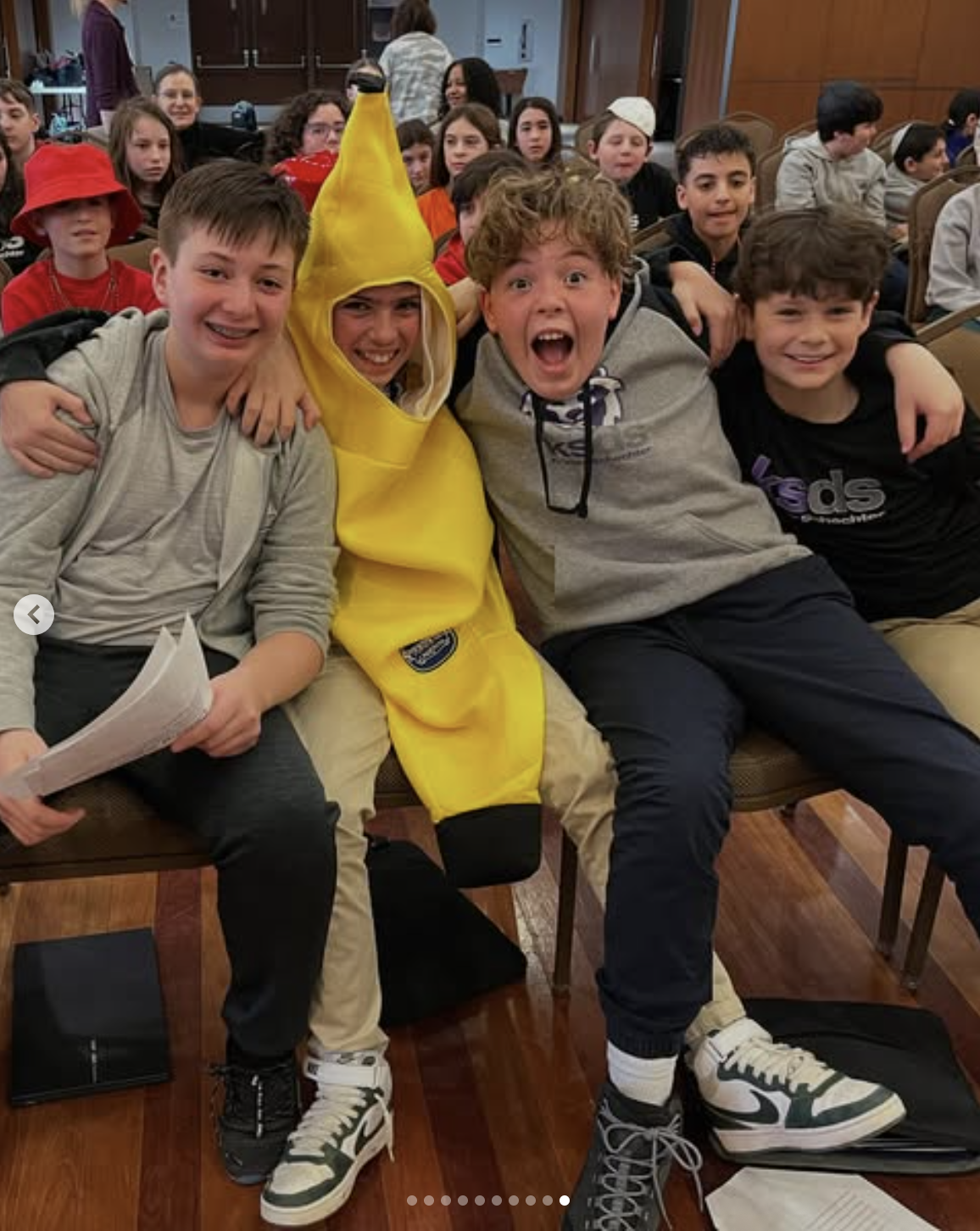
6th Grade Great Fruit Debate
The Great Fruit Debate integrates General and Judaic learning, enriches students’ connection to Israel, builds public speaking skills, and promotes teamwork + critical thinking
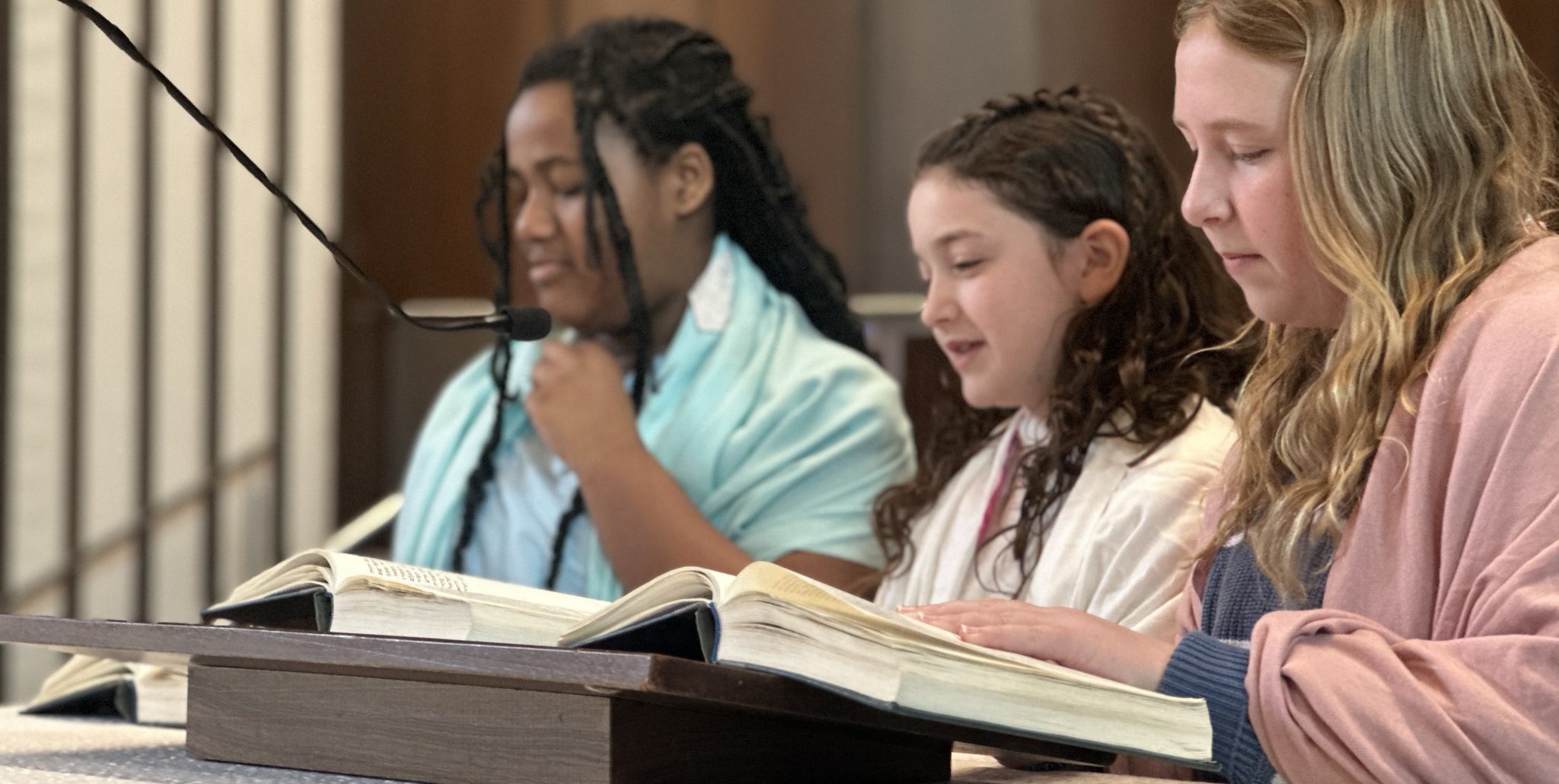
5th Grade Tallit Workshops
At KSDS, crafting unique tallitot for our middle school tefillah has been a treasured tradition for 5th graders. Students delve into the significance of wearing a tallit, collaborate with …